
It was supposed to be a prestige friendly. England, newly crowned back-to-back European champions, hosting Brazil, nine-time and reigning South American champions, at the Etihad in the first international fixture since the Euros and Copa América. Injuries depleted the Lionesses. Meanwhile, Arthur Elias and The Seleção arrived with a youthful squad - one eye undoubtedly fixed on the 2027 World Cup, when they take on hosting duties.
Brazil were 2-0 up after just 20 minutes.
They’d done it by exploiting the defensive transition weakness that has been haunting England for the last three years. Elias’s side were physical, aggressive, and utilised a player-to-player marking system that refused to let the Lionesses settle. Brazil pressed high, defended on the front foot, forced errors and most importantly, capitalised on every loose touch.
21 minutes in, Angelina received her marching orders after cynically fouling Ella Toone as she was clean through on goal.
Down to ten and still leading by two, Brazil went into survival mode. Unsurprisingly, England dominated possession in the second half, as they looked to take advantage of the extra player. The Etihad crowd grew increasingly hostile, booing every Brazilian touch as the Olympic silver medalists dug in and time-wasted relentlessly.
The game turned fractious; there were tactical fouls from both sides that often resulted in players squaring up. Following a stoppage after Chloe Kelly and Luany had a “disagreement” over whose ball it was, the noise intensified. As the Brazilian refused to hand it over, the Etihad reached pitching point.
Then Tarciane turned to the stands and applauded.
A slow, deliberate, sarcastic round of applause directed straight at the England supporters booing her team. It was petty. It was unnecessary. It was absolutely brilliant.
I love watching Tarciane play, and I’m not entirely sure that’s a rational response.
I mean, there are technically cleaner defenders. There are more positionally disciplined centre-backs. When she’s on the pitch, though, something shifts. The game becomes a constant battle. Opponents have to account for her in ways that go beyond tactical instructions.
That applause at the Etihad told you why. The 22-year-old Brazilian defender is always up for the fight. Every game she plays, she’s always right on the edge, and that is precisely what makes her exceptional.
This isn’t a flaw that needs to be managed. It’s her superpower.
Tarciane grew up in Belford Roxo, a working-class city in the Rio de Janeiro metropolitan area. In 2019, she joined Fluminense’s youth system and began training with the first team immediately. In the summer of 2021, she had moved to Corinthians, where, that same year, she lifted the Copa Libertadores - South America’s most prestigious club trophy.
After three years, multiple league titles, plus a second Copa Libertadores, the NWSL and Houston came calling. Barely nine months later, in January 2025, she made the move to Lyon, the eight-time European champions. The trajectory is almost absurdly compressed for a 22-year-old defender.
As impressive as it sounds, the CV doesn’t truly show who she is as a player. Facts don’t explain why I find her so compelling to watch.
When I say she’s “always up for the fight”, I’m not using it as a throwaway line. It really is the first thing that hits you when you watch her. Tarciane plays like every second on the pitch is a chance to prove something. She’s not reckless; her timing is far too good for that. She’s not cynical either, because she knows exactly where the line is and doesn’t cross it. What she is is confrontational. Defiant. At 1.83m tall, she knows how to use every centimetre of her frame. She leaves it all out there on the pitch. In contests for possession, she goes all in. In recovery runs, she sprints back like it’s a personal battle. Opponents who try to impose themselves usually discover she’s not one to be tested.
This edge isn’t separate from her technical ability. It actually feeds into it. The aggression makes attackers hesitate, causing them to second-guess their next move. Her physicality limits the opposition to a second less on the ball, forcing them to change how they shape their attacks. Tarciane doesn’t just defend, she disrupts.
Women’s football has space for this, and honestly, we need more of it. Players who refuse to sanitise themselves, who know that personality is part of performance and don’t even try to apologise for it. Tarciane isn’t out there trying to be liked. She’s there to win. In a sport that still, at times, expects women to be palatable first and competitive second.
Her move to Lyon was inevitable. They didn’t pay for potential. They invested in a defender who already knows exactly who she is. She plays with clarity and conviction, and refuses to dilute the aspects of her game that make her stand out.
You can see the willingness to confront in every game she plays. It’s not something she saves for big games or important moments. It’s the only way she knows how to defend. It shows up in the smallest actions on the pitch; the duels she decides to enter, the ones she doesn’t - there’s a pattern to it once you start paying attention.
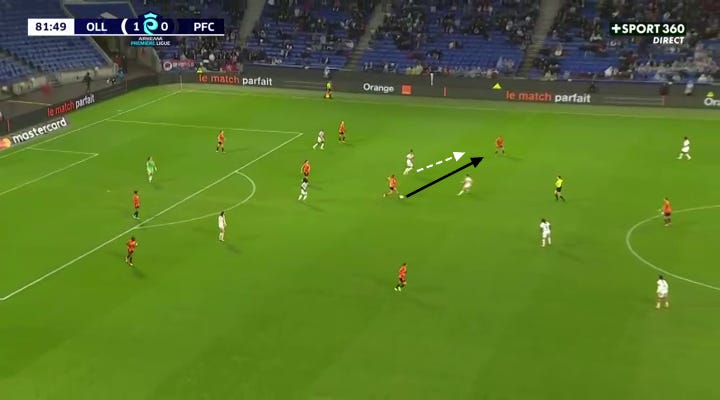
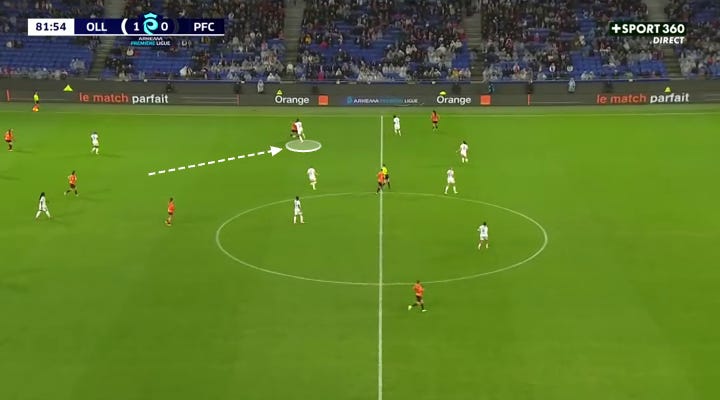
This is a moment in the game which encapsulates her perfectly. Lyon loses the ball on the edge of the opposition box, and Tarciane (who is playing as a right-back) is high up the pitch. Her first thought isn’t to track back into shape, it’s to win the ball back.
She snaps into a sprint, already knowing she’s going to win the duel. She doesn’t just slow the Paris FC attack; she ends it. She closes the distance in seconds, initiates the contact, forces the turnover, and Lyon recover possession.
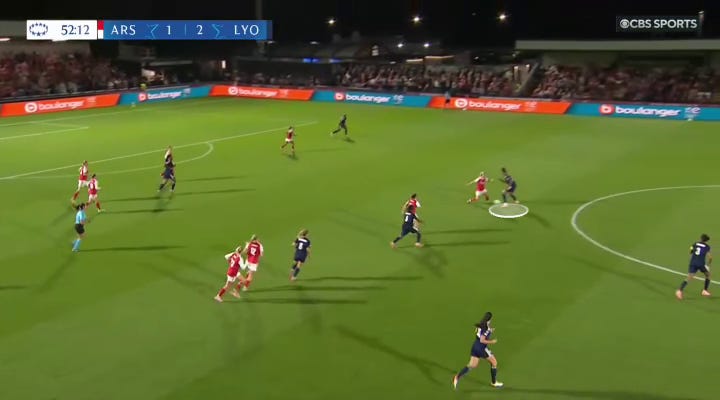
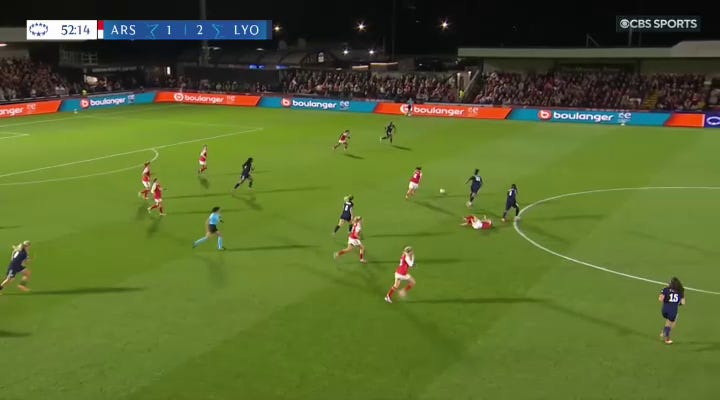
This moment, against Arsenal, sticks in my head. Chloe Kelly barely has time to control the ball before Tarciane steps in with that mix of force and precision that defines her game. She wins the challenge and sends Kelly to the ground in the process. There’s no theatrics and no hesitation. Just Tarciane making sure the moment doesn’t become a transition.
What I love about this example is that she doesn’t admire her work, even for a heartbeat. As soon as the ball spills loose, she’s gone again, accelerating across, chasing down Mariona as she tries to break away with the ball. One contest seems to fold into the next, as if her game is built on a refusal to give the opponent a single clean breath.
It’s these small sequences that you can almost miss in the chaos of a match that tell you everything. Tarciane’s desire to press, to chase, to win pushes Lyon further. She sets in motion a series of chain reactions by refusing to be passive for a second.
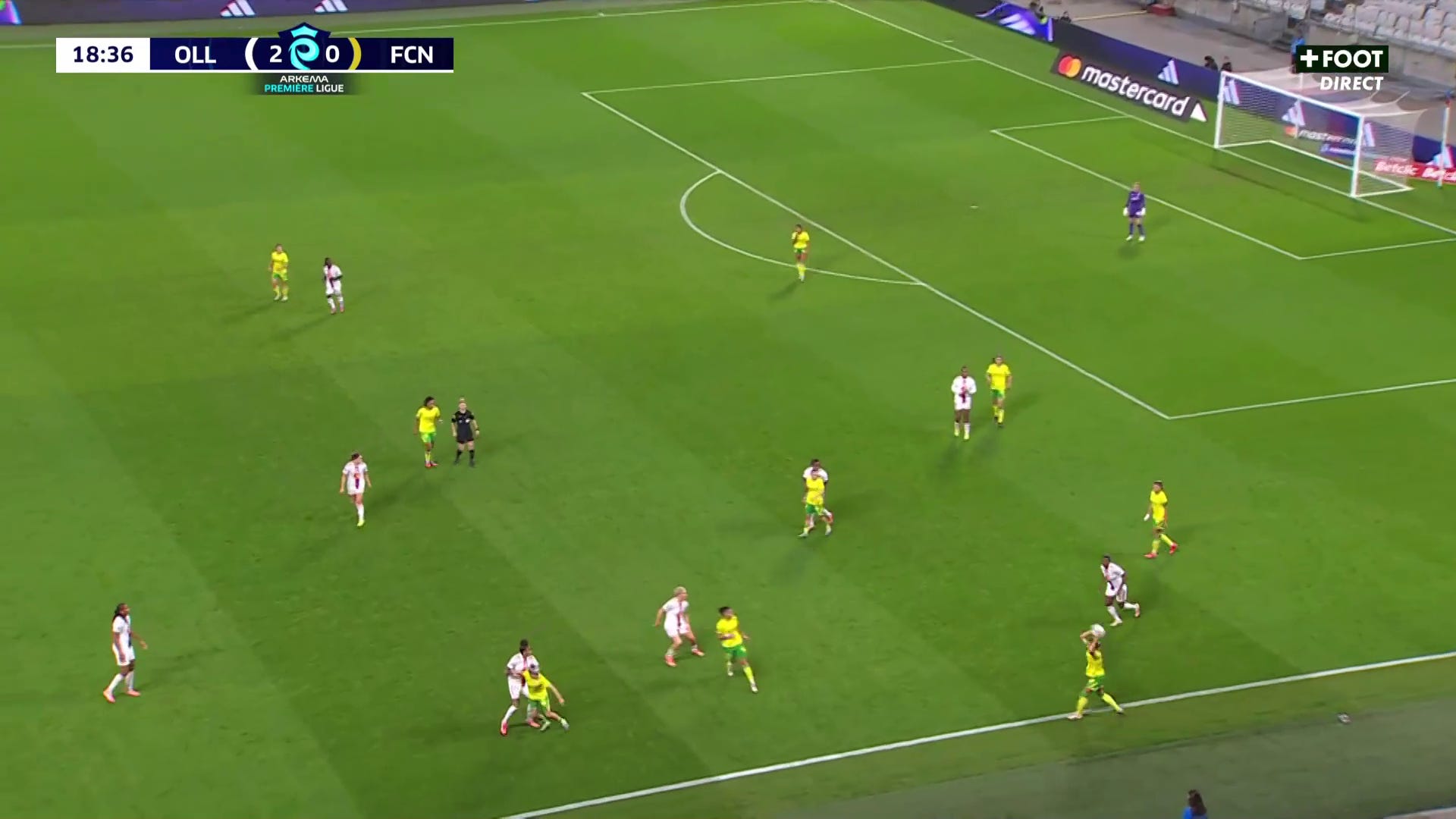
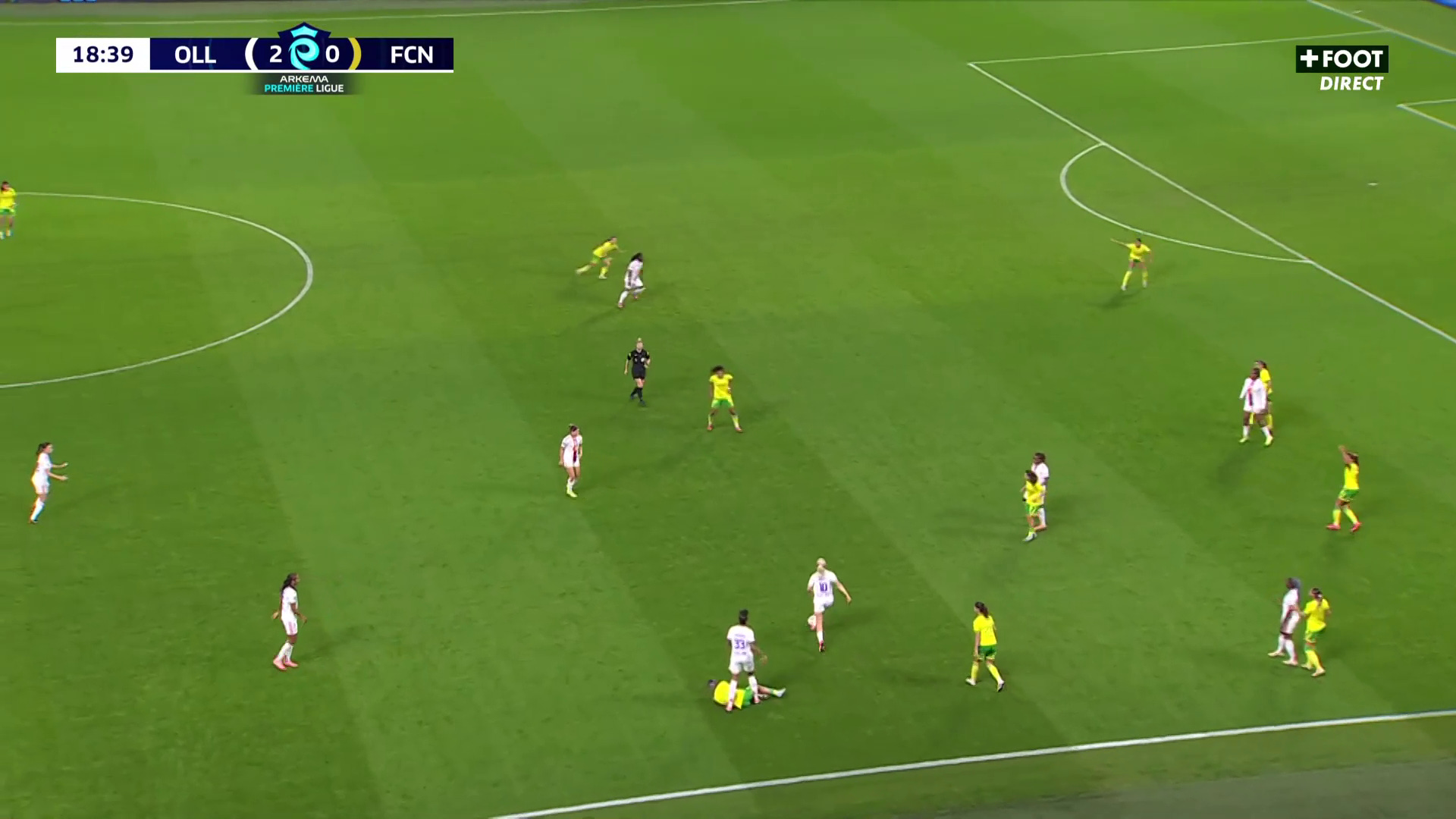
It’s the small, maybe even almost throwaway moments that say more about her than any stat ever will. Take this throw-in against Nantes as an example. The ball hasn’t even left the player’s hands yet, and Tarciane is already shaping the duel. She angles her body, making it absolutely clear that receiving the ball cleanly will be a challenge.
By the time the throw reaches the Nantes player, it’s too late. Tarciane has already made sure there’s no way past. The Nantes player ends up on the floor, she regains possession, and Lyon move away with the ball. Nothing about it feels dramatic in real time. It’s just how she defends. She makes routine in-game actions feel confrontational, and she does it without blinking.
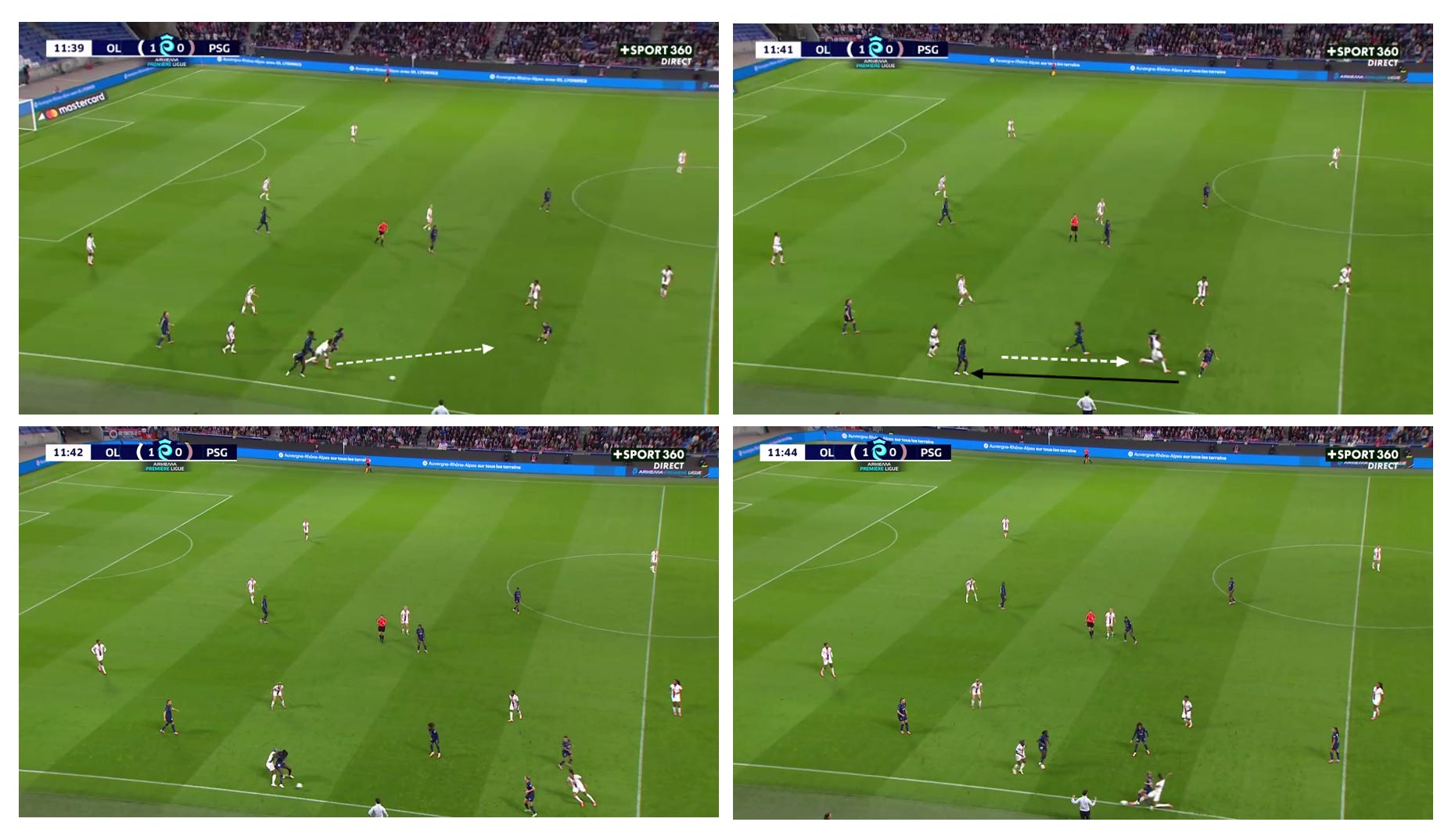
There’s another moment, this time against PSG, that sticks with me. Tarciane actually loses the ball near the touchline, a rare slip as she’s usually pretty confident with the ball. Again, she snaps straight into a sprint, hounding Jackie Groenen before she’s even fully opened her body. The pressure is immediate and uncomfortable. The PSG player panics and fires a rushed pass to her teammate, who is already under pressure. She tries to return the pass without thinking. Tarciane has already covered the ground, though. One stride, two, a third to launch, and she’s in with a sliding tackle that forces the ball out of play. It’s not tidy. It’s not elegant. It’s not meant to be. She refuses to let her own mistake become someone else’s opportunity.
A single duel doesn’t mean much in isolation, but stack them together, and a pattern starts to emerge. Tarciane turns these scraps into territorial wins. She drags the game into her rhythm, forcing opponents into movements they don’t want to make. Even seasoned attackers like Chloe Kelly and Beth Mead kept switching sides to escape her. The accumulation is suffocating.
Positioning, timing, and angles can all be refined, but you can’t teach that instinct she has - the ability to make a match bend to her tempo. That’s what Tarciane brings. Her presence alone makes opponents hesitate and rethink.
Tarciane doesn’t just play football; she imposes herself on every game. That’s exactly why I love watching her. It’s not just the tackles or the timing; it’s her attitude. You really get the sense that every single action means something, and there’s not a second of the game that she will let pass her by quietly. Yes, there are cleaner defenders, and there are calmer ones, but there are few who change the intensity of a match the way she does. She makes you feel something. That’s the only thing that matters.